
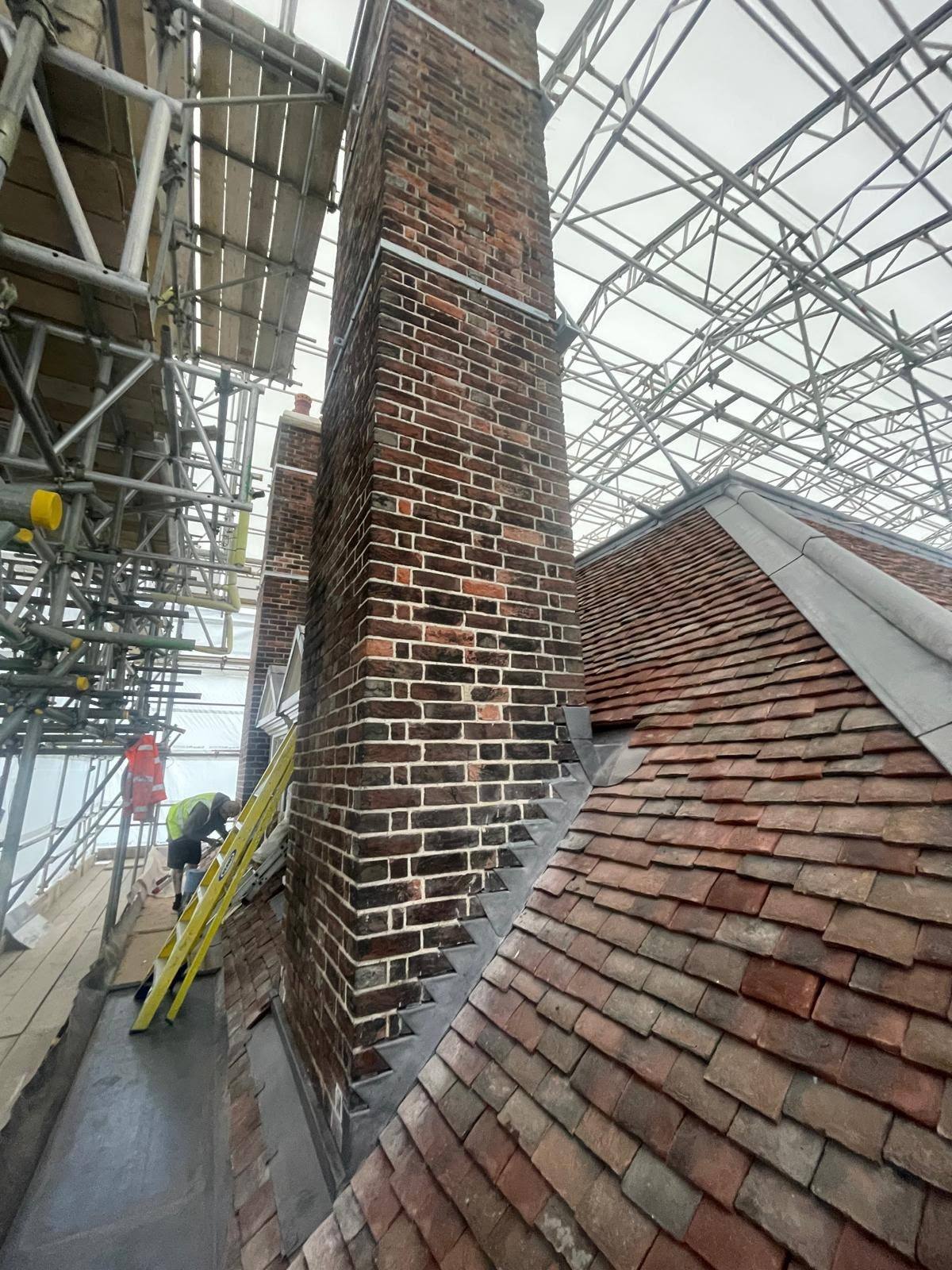
Movement joints — commercial & structural
Expansion & Movement JointSealing in Chathamjoints that flex, not split
Movement joints sealed to the geometry the movement actually demands — sized, backed and tooled so the bead absorbs a hot summer and a heating season without tearing, and without a crack line appearing through your finished floor.
£2m public liability cover, CITB and CSCS accredited, RAMS issued on request, and quotes taken off your joint schedule free of charge.
£2m cover
public liability insurance
CITB & CSCS
accredited on site
RAMS on request
for commercial jobs
Free quotes
photo quotes on small jobs
Chatham based
Kent, London & South East
The service
What this work involves
— and who it is for
What expansion joint sealing involves
An expansion or movement joint is a deliberate gap designed into a structure so that thermal expansion, shrinkage, settlement and structural deflection have somewhere to go. Sealing it is not about filling a hole — it is about installing a flexible bridge that stays watertight and intact while the two sides of the joint move relative to each other, sometimes by several millimetres each way.
The work involves establishing the joint width, calculating the depth needed for the expected movement, installing closed-cell backing rod to set that depth and prevent adhesion to the back of the joint, and applying a low-modulus sealant that can extend and compress across its rated range. Beads are tooled to a profile that keeps the sealant in full contact with both joint faces.
Who it is for
Mainly main contractors, developers and construction companies on new builds, office refurbishments, building refurbishments and schools — anywhere floors, walls, slabs and frames have designed movement joints that need sealing before handover.
Also property owners and managing agents dealing with existing joints that have failed: split beads in car park decks and screeds, torn floor joints in warehouses and retail units, and cracked wall joints that are letting water through.
When it is needed
On new work, once screeds and slabs have taken their initial shrinkage and adjacent finishes are complete — sealing a joint too early means the bead is stretched permanently by shrinkage that has not finished happening.
On existing buildings, as soon as a joint shows a split down its centre, has detached from one face, is squeezing out proud of the surface, or has broken down to the point where dirt and water are getting into the structural gap. Floor joints in trafficked areas also fail mechanically as forklifts and trolleys break down the edges, and want reinstating before the concrete arris starts spalling.
Why professional application matters
Movement joints are the one sealant application where the maths genuinely decides the outcome. A sealant rated for 25% movement in a 10mm joint accommodates 2.5mm. If the joint actually moves 4mm, it will fail no matter how carefully it was applied — the joint needed to be wider, or a different product used.
Then there is three-sided adhesion, the most common and most destructive error in the trade. Filling a joint solid so the sealant bonds to the back as well as the two sides removes almost all of its ability to stretch. It tears cohesively down the centre at the first significant movement cycle, which is exactly what you see in split floor joints across the country. Backing rod is not an optional extra — it is what makes the joint work.
What it costs to leave it
A failed seal never
stays a small problem
A failed movement joint is rarely just a cosmetic line. It is an open channel through a floor slab or wall into the structure, in the exact location the designer expected to move — which means anything that goes wrong there keeps getting worse with every thermal and load cycle.
Water into the structure
Split wall and deck joints admit water straight into the build-up, where it reaches reinforcement, insulation and fixings. Corrosion and frost damage in a movement joint are expensive because access to repair them means breaking out finishes.
Spalled floor edges and trip hazards
Once a floor joint sealant breaks down, wheel loads hit the unsupported concrete arris directly. The edges chip away, the gap widens, and what was a resealing job becomes concrete repair plus resealing — with a trip and safety issue in the meantime.
Cracks appearing through new finishes
A joint that cannot move transfers its stress somewhere else. That usually shows as a crack through screed, tiling or plaster next to the joint — visible damage in a brand-new fit-out that no amount of decoration hides.
Mistakes we get called out to fix
- Filling the joint solid with sealant and no backing rod, creating three-sided adhesion and a bead that tears down the middle.
- Using a high-modulus or general-purpose product where the joint needs a low-modulus sealant rated for high movement.
- Sealing a joint narrower than the movement requires, instead of flagging that the joint width itself is inadequate.
- Sealing new screeds and slabs before initial shrinkage has taken place, so the bead starts life already under tension.
- Grouting or mortaring over a movement joint to tidy it up — which guarantees a crack, usually within a season.
How a job runs
The order of work,
start to finish
- 01
Joint survey & movement assessment
We measure joint widths and depths, identify the movement each joint has to accommodate, and flag joints where the width is inadequate for the expected range.
- 02
Free quote & product specification
A fixed written price against measured runs, naming the low-modulus product and backing rod sizes, checked against your specification.
- 03
Break out & preparation
Failed sealant and any loose material removed, joint faces cleaned back to sound substrate, edges made good where required and primer applied where specified.
- 04
Backing rod & sealing
Closed-cell rod sized above joint width is compressed to set depth and prevent back adhesion, then the sealant is applied in a continuous pass.
- 05
Tooling, cure & verification
Beads are tooled to profile, protected while curing, then checked along their full length before sign-off with your site manager.
What you get
The difference a properly
detailed finish makes
Movement absorbed for years
Correct width-to-depth ratio and two-sided adhesion mean the bead uses its full rated extension instead of failing on its first hot spell.
No cracks migrating into finishes
A joint that works keeps stress where the designer put it, rather than transferring it into screed, tiling and plaster.
Floor edges protected
Properly filled and profiled floor joints support the concrete arris against wheel loads, preventing spalling and trip hazards.
Watertight through the build-up
Continuous, correctly bonded beads keep water out of slabs, decks and wall build-ups where corrosion and frost damage start.
Inspection-ready lines
Consistent width, consistent profile and clean adjacent surfaces, so runs get signed off instead of snagged.
Honest joint assessment
If a joint is too narrow for the movement it will see, we tell you before we seal it rather than after it fails.
In detail
Materials, methods
and the variations we cover
Materials: low-modulus sealants and backing rod
Movement joints are sealed with low-modulus sealants — typically neutral-cure silicone or polyurethane-based products from Mapei, Illbruck, CT1 and Arbo — selected for high movement accommodation and for compatibility with the substrate. Low modulus matters because the sealant should stretch under movement without applying enough stress to tear itself off the joint face or damage a weak substrate such as render or lightweight block.
Backing rod is the other half of the material specification. Closed-cell polyethylene rod is used because it does not absorb water and does not bond to the sealant, so the bead is free to stretch across two faces. Rod diameter is chosen larger than the joint width so it compresses into place and stays put, and its depth is set so the finished bead has the right thickness for the joint width — not so deep that the bead is wastefully thick, and not so shallow that it is too thin to survive movement. In trafficked floor joints the products change again to harder-shore polyurethane sealants that can carry wheel loads without being cut and torn.
Method: geometry decides the outcome
For most movement joints the target is a width-to-depth ratio of about 2:1, bonded to two opposing faces only. A 20mm wide joint therefore wants roughly 10mm of sealant depth, set by backing rod, giving the bead the geometry to extend and compress through the product's full rated range. Wider joints and joints with high movement need proportionally more careful sizing, and there is a point at which the honest answer is that the joint itself is too narrow and should be cut wider before sealing.
Application follows preparation. Old sealant and debris are removed rather than sealed over, joint faces cleaned to sound material, arrises made good where they have broken down, and primer applied where the manufacturer requires it on porous concrete. The bead is gunned in a continuous pass, tooled immediately to press it into contact with both faces, and left protected during cure — a floor joint walked on or trafficked before the sealant has skinned is a joint that will be back on the snag list.
Variations we cover
Floor and slab expansion joints in warehouses, retail units, plant rooms, corridors and car park decks. Structural movement joints through walls, both internally and externally. Screed and tile movement joints in wet areas and large tiled floors. Joints between structural frames and infill walls. Deck-to-wall and slab-to-column perimeter joints. Masonry expansion joints in brickwork and blockwork. Trafficked joints requiring harder-shore products. Full removal and replacement of failed joints previously sealed by others.
Where the joint is visible in a finished space we can colour-match the sealant to the floor, tile or wall finish so a functional joint reads as a designed line rather than an afterthought.
Commercial and residential contexts
The great majority of movement joint work is commercial: new builds, refurbishments, schools and industrial units, priced from joint schedules and delivered against a programme with RAMS on request, CSCS-carded operatives and £2m public liability cover in place.
Residential movement joints do exist and get overlooked — large tiled floors with perimeter and field movement joints, screeded extensions abutting the original structure, and long masonry runs on new-build housing. The engineering is identical at smaller scale, and the failure mode is the same: cracked tiles and split beads where a joint was filled solid instead of sealed as a movement joint.
Questions
What customers ask
before booking
- How do you price expansion joint sealing?
- By measured joint run, after a site visit or from your joint schedule. Quotes are free and fixed in writing, with the sealant and backing rod specification named so it can be checked against your specification.
- Why do movement joints keep splitting down the middle?
- Almost always three-sided adhesion — the joint was filled solid without backing rod, so the sealant is bonded to the back of the joint and cannot stretch. It tears down its centre at the first real movement cycle. Correct backing rod fixes it permanently.
- Can you widen a joint that is too narrow?
- We will tell you when a joint is too narrow for the movement it has to absorb. Cutting joints wider is concrete work and is normally carried out by the contractor or a specialist cutting firm; we then seal to the corrected geometry.
- How long does the work take?
- A single floor plate of joints is usually days rather than weeks, depending on how much failed sealant has to be broken out. We give you a duration and visit pattern with the quote so it fits your programme.
- How long should a movement joint last?
- Internally, a correctly sized joint in a non-trafficked location can last for decades. Trafficked floor joints in industrial use are wearing items and are worth inspecting on a maintenance cycle. We do not advertise a guarantee, so we are specific instead about what the joint will and will not tolerate.
- Can you seal joints in car parks and trafficked floors?
- Yes, using harder-shore products designed to carry wheel loading rather than soft silicone, which would be cut and dragged out of the joint by traffic.
- Do you need the area closed off?
- Only the joint run itself plus a working margin, and for as long as the sealant needs to skin. We plan phasing so occupied buildings and live warehouses can keep operating around us.
- Can you provide RAMS and accreditation for our site?
- Yes — Risk Assessment Method Statements on request, CITB and CSCS accreditation, and £2 million public liability insurance. Documents are sent before induction.
- Do you take on urgent joint failures?
- Where water ingress or a safety issue is involved we prioritise as far as the diary allows. We are a two-person team, so we will always give you an honest date rather than a promise we cannot keep.
- Which areas do you cover?
- Kent, London and the South East from our base at The Historic Dockyard in Chatham — including Maidstone, Sevenoaks, Tunbridge Wells, Kings Hill, Meopham, Whitstable, Tenterden, Bexley and the City of London.
Related sealant services
- Commercial silicone sealant application
Sealant packages for office refurbishments, new builds, building refurbishments and schools, worked to the main contractor's programme.
- Floor line & wall joint mastic
Consistent mastic lines to floor and wall junctions across large commercial areas — corridors, plant rooms and open floor plates.
- External silicone sealant
Weatherproof external joints specified for UK exposure and movement — brick, render, stone, cladding and copings.
- Cladding & curtain walling sealing
Facade and curtain walling joints sealed to line and detail at height, from the access provided.
- All sealant services
Where we work
Based at The Historic Dockyard in Chatham, covering Kent, London and the South East — including Sevenoaks, Tunbridge Wells, Maidstone, Kings Hill, Tenterden, Whitstable and City of London.
Get your movement joints sealed to work, not just to look filled
Send the joint schedule or book a site visit. We will measure the runs, specify the product and backing rod, and come back with a free fixed price and RAMS ready to issue.
£2m public liability cover · CITB & CSCS accredited · RAMS on request · Mon–Sat, 7am–7pm · Sunday closed